How Often to Pump Your Septic Tank
Quick answer: The U.S. EPA says a typical household septic tank should be inspected every 1 to 3 years and pumped every 3 to 5 years. The exact interval depends on tank size, how many people live in the house, water use, and how much sludge and scum have built up. Use the table below as a starting point, then have a pro measure the layers. Additives do not replace pumping.
This is an information page, not a lead-gen directory. We do not sell pump-out services.
We may earn a commission if you buy through links on this page, at no extra cost to you. Full disclosure and sources are at the bottom of the page.
What does the EPA say?
EPA’s care guide says the average household system should be inspected at least every three years by a septic professional, and that household tanks are typically pumped every three to five years. The FAQ gives the same pumping range and says inspections are generally every 1 to 3 years. Systems with electrical floats, pumps, or other mechanical parts should be inspected more often, generally once a year.
The same EPA page tells a professional to pump when:
- the bottom of the scum layer is within 6 inches of the bottom of the outlet, or
- the top of the sludge layer is within 12 inches of the outlet, or
- sludge and scum make up more than 25 percent of the liquid depth.
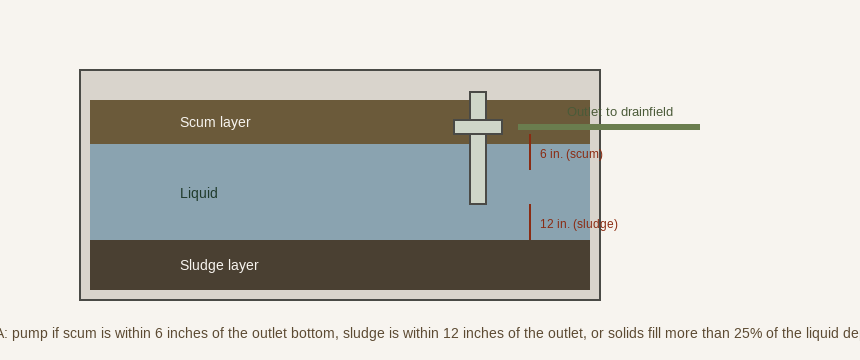
Those measurements are why the pumper needs to open the tank. If the lids are buried, find them first (How to find your septic tank lid) or bring them to grade with a riser. A cracked lid should be replaced before or during the visit (septic tank lids and covers). Ask the pumper to clean the effluent filter at the same time.
How often should you pump, by tank size and household size?
The years in this table are estimates for year-round homes, published by Virginia Cooperative Extension (SPES-574, 2024) and adapted from Mancl (1984). Oregon State, Maryland, and Arizona extensions publish the same Mancl figures. They are not a legal schedule, and they are not a substitute for measuring sludge and scum.
Estimated years between pump-outs
| Tank size (gallons) | 1 person | 2 people | 3 people | 4 people | 5 people | 6 people | 8 people |
|---|---|---|---|---|---|---|---|
| 1,000 | 12.4 | 5.9 | 3.7 | 2.6 | 2.0 | 1.5 | 1.0 |
| 1,250 | 15.6 | 7.5 | 4.8 | 3.4 | 2.6 | 2.0 | 1.4 |
| 1,500 | 18.9 | 9.1 | 5.9 | 4.2 | 3.3 | 2.6 | 1.8 |
| 2,000 | 25.4 | 12.4 | 8.0 | 5.9 | 4.5 | 3.7 | 2.6 |
Source: Virginia Cooperative Extension SPES-574 (2024), adapted from Mancl (1984).
How to read it: a 1,000-gallon tank in a four-person house is estimated at 2.6 years, which is sooner than EPA’s 3-to-5-year rule of thumb. A two-person house with the same tank is estimated at 5.9 years. Very long intervals for one-person homes assume light use; do not skip inspections just because the number is large.
Pump sooner if:
- You use a garbage disposal. Oregon State, North Carolina State, Maryland, and Arizona extensions all say disposals add solids and shorten the interval.
- Water use is high (long showers, a leaky toilet, frequent laundry).
- Guests or a home business add people the table does not reflect.
You may pump less often if the house is a lightly used vacation home with a correctly sized tank (North Carolina State and Maryland extensions note this). Still inspect; a tank that is never opened can leak or send solids to the drainfield without obvious indoor symptoms. EPA warns that “we have never pumped and nothing is wrong” can mean a leak, or a tank already sending solids out.
Some counties require a pump-out every five years no matter how full the tank is. Virginia Extension flags that for some Virginia counties. Check your local health department.
Worked example
A four-person household has a 1,000-gallon tank. The last pump-out was three years ago. The outlet lid is buried.
- The Mancl / Virginia Extension table says about 2.6 years for this size and occupancy, so they are already at or past the estimate. EPA’s 3-to-5-year range is a general starting point, not a reason to wait longer.
- They should schedule a pumper now, not “in a year or two.”
- Before the truck arrives, they can locate both lids. Two-compartment tanks often need both opened.
- After the pump-out, a riser kit and a sound lid make the next visit a lid-off job instead of a dig. Ask the pumper to clean or check the effluent filter.
If this family also used a garbage disposal every day, they should plan on the short side of the estimate—closer to every two years—until a pro has measured actual sludge buildup.
Do septic tank additives let you pump less often?
No. EPA does not recommend bacteria or chemical additives for household systems, and its SepticSmart guide says periodic pumping is the only reliable way to keep the tank working. See Septic tank additives: do they work?.
When should you call a pro?
- You do not know the tank size or the last pump-out date.
- Drains are slow, the yard is soggy over the drainfield, or you smell sewage.
- A septic alarm is sounding.
- You cannot safely uncover the lids. Never enter a septic tank.
This page is general maintenance information, not legal, code, or engineering advice. Follow local rules and the judgment of the person who measures your tank.
Frequently asked questions
Is every 3 to 5 years enough?
It is EPA’s typical range, not a guarantee. A small tank and a large household often need pumping sooner, as the table shows. Inspection and sludge measurements beat a calendar alone.
Should both compartments be pumped?
Yes, when the tank has two compartments. North Carolina State and Maryland extensions say to have both pumped. That usually means opening both lids.
Does a garbage disposal change the schedule?
Yes. Extensions consistently say disposals add solids, so plan on more frequent pumping.
What if you have never pumped the tank?
EPA says that can mean light use, a leaking tank, or a tank already sending solids to the drainfield. Have it inspected and pumped rather than waiting for a backup.
Related guides
A first-timer’s septic maintenance guide · How to find your septic tank lid · Do I need a septic riser? · Septic tank lids and covers · Effluent filter cleaning and replacement · Septic tank additives
Sources and notes
Affiliate disclosure: Some links on this page will be affiliate links. If you buy through them, we may earn a commission at no extra cost to you. We have not tested any products, and this page has no product table.
Last checked: November 27, 2026 (America/Chicago).
- U.S. EPA, How to Care for Your Septic System: inspect at least every three years; typical pump-out every 3 to 5 years; 6-inch / 12-inch / 25 percent pumping criteria; annual inspection for systems with floats or pumps.
- U.S. EPA, Frequent Questions on Septic Systems: inspect every 1 to 3 years; pump every 3 to 5 years; why an unpumped tank can still be a problem.
- Virginia Cooperative Extension, What to Expect When Getting Your Septic Tank Pumped (SPES-574, 2024), Table 1, adapted from Mancl, K. 1984. “Estimating Septic Tank Pumping Frequency.” Journal of Environmental Engineering 110(1): 283–285.
- Oregon State University Extension, Septic tank maintenance (EC 1343, revised March 2022, reviewed 2025): same Mancl table; more frequent pumping with a garbage disposal.
- NC State Extension, Septic Systems and Their Maintenance, and University of Maryland Extension FS-1105: pump both compartments; disposals and vacation-home caveats.